Showing posts with label Synchronicity. Show all posts

Tuesday, December 3, 2013

As Destinies Entwine....Is there More waiting in the Wings?

Life is filled with secrets. You can't learn them all at once. 
                                                 -Dan Brown, The Da Vinci Code

Coincidence was a concept he did not entirely trust. As someone who had spent his life exploring the hidden interconnectivity of disparate emblems and ideologies, Langdon viewed the world as a web of profoundly intertwined histories and events. The connections may be invisible, he often preached to his symbology classes at Harvard, but they are always there, buried just beneath the surface.
-Dan Brown, The Da Vinci Code


Our word 'clue' is derived from the Anglo-Saxon clew, meaning a 'ball of thread'. The most famous ball of thread in Western culture belonged to Ariadne, the beautiful daughter King Minos of Crete, who fell in love with Theseus...sent to the great Labyrinth of Knossos to be sacrificed to the Minotaur. 
-Anthony Stevens, Ariadne's Clue, p.3

This reflection arises really from the previous, "As Destinies Entwine....A Love Story". The story is ongoing. The Garvie-Adam connection may yet have a sequel one day. There may be more to this thread that has yet to disclose itself to us.

When we first visited Scotland in 2004 we homed in on Aberdalgie about three miles south-west of Perth. Several generations of my Garvie ancestors lived there. My great grand father Laurance Garvie was born at West Lodge, Dupplin Castle, Aberdalgie in 1845. His father, John Garvie, was a forester on the Dupplin Estates. John Garvie's parents, James Garvie and Janet Hutton were also from Aberdalgie. Though I know of no know connection, the Rev William Garvie was the local minister at the time.
Cousins Ken and Colin Garvie
Descendants of John and Janet Garvie
Aberdalgie

The primary object of our visit to the Aberdalgie Church was to see the Garvie graves in the church graveyard. The one grave of immediate interest to me was the grave of Janet Luke, John Garvie's wife and several of their children. It was this grave that pointed us to the Cemetery in Balgay.  The monument read...

IN LOVING MEMORY OF
JOHN GARVIE
DIED 21ST AUGUST 1898 AGED 79
INTERRED AT BALGAY CEMETERY, DUNDEE
AND JANET LUKE HIS WIFE
WHO DIED 15TH MAY, 1884 AGED 66
ALSO THEIR CHILDREN
MARGARET WHO DIED 16TH JULY
1875 AGED 21
ELIZABETH WHO DIED 26TH APRIL
1881 AGED 33
AND
CHARLES, JESSIE & MARY ANN
WHO DIED IN INFANCY
JANE GARVIE DIED 29TH JULY
1928 AGED 83 YEARS
---
ERECTED BY HER DAUGHTER JANE
PEACE PERFECT PEACE
-=O=-

John Garvie's father was James Garvie who we believe was a son of James Garvie and Janet Glass. (It might be that the two James' are the same person and Janet Hutton was a second marriage. Janet Glass had died early in 1812. In September 1812 James Garvie married Janet Hutton. Unfortunately the records are incomplete.) Whatever, the James Garvie of Janet Glass was born 15 Oct 1753 in Scone.

The Garvies of Scotland proliferate around the legendary Scone near Perth in Perthshire. According to a letter from J C Garvie Macleod to the editor  of  the Oban Times, Spenthorn, West Park, Leeds (date unknown) it is said that the Garvies of Perthshire "are descended from John Garbh, seventh Maclean of Coll, through one of his sons, probably John of Totaronald." According to him, John Garbh was wounded at the Battle of Inverkeithing, Fifeshire (1651) and did not return to Coll. His three sons (or grandsons) rented Upper Balgarvie, Lower Balgarvie and the Mill of Balgarvie in the Perthshire, Parish of Scone from the Earl of Mansfield.  Their descendants were tenants of Muirton, Haggis Hall and other farms near Perth.

In Scots the prefix "bal" means "place or town of" so "Balgarvie" means "Garvie's Place". "Balgay" means "Place of Breezes".

Walking around the small Aberdalgie cemetery we came across two mysterious Adam family memorial stones side by side....
Sylvia Adam between the two Adam Memorials
Aberdalgie, Perthshire

The memorial stone of the first read in part...

IN MEMORY OF
JAMES ADAM
WHO DIED AT BALGARVIE, SCONE
5TH FEBY 1934 AGED 44 YEARS
BELOVED HUSBAND OF
ANNIE ANDERSON
WHO DIED
2ND FEBY 1972 AGED 80 YEARS
.....

The second stone read in part...

IN LOVING MEMORY OF
JAMES ADAM
BELOVED HUSBAND OF
JANET NIVEN
WHO DIED 3RD JUNE 1925
AGED 63 YEARS
.....
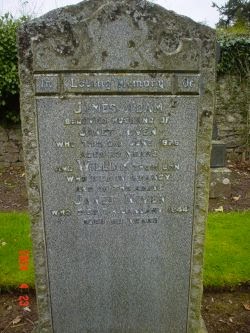
Other than the reference to Balgarvie, Scone there is no other indication that there is any link between the Garvies and Adams of Aberdalgie except that from other records, James Garvie and Janet Niven came from Lundie is a small hamlet 10 miles northwest of Dundee. They had Dundee connections too, Dundee where John Garvie and Elizabeth Fawns are buried (see previous blog).

The coincidence of "Balgarvie" may simply serve as a symbolon,  a pointer. Anthony Stevens explains this beautifully in his Ariadne's Clue (p.12):

The Greek noun symbolon referred to a token or tally which could be used as a verification of identity. An object, such as a bone, would be broken into two halves and each given separately to two people...who could then identify each other by producing both halves and checking that they fitted together. Each tally-holder knew his own half to be genuine. If perfect fit occurred between the two halves of the symbolon, a Gestalt was suddenly created out of the familiar (known) and the strange (unknown) parts and the bona fides of each individual was established as sharing the same allegiance.

Synchronicities work in such a way too. It is the "Adam Affect", the “Wow Moment”, when Adam first met Eve he exclaimed, "This one at last is bone of my bones and flesh of my flesh!" (Gen 2.23). Diese endlich! The word Gestalt or “wholeness” is a good one in this context.

Stevens continues...

The conjunction of sym (together) with ballein (to throw) emphasizes the idea that the strange must be 'thrown together' with the familiar to construct a bridge of meaning between the known and unknown. In psychological terms, something unconscious is connected with consciousness, resulting in the experience of new meaning.

As the one monument stone pointed me to Balgay so the other was directing me to Balgarvie. Together they were the symbolon building a bridge from the known to the unknown.I am inclined to the "doctrine of the more"!

Further Reading:

Henry Z Jones Jr, Psychic Roots, Serendipity & Intuition in Genealogy, Genealogical Publishing Co. In. Baltimore
Henry Z Jones Jr, More Psychic Roots, Further Adventures in Serendipity & Intuition in Genealogy, Genealogical Publishing Co. In. Baltimore
Anthony Stevens, Ariadne's Clue, Princeton University Press, Princeton

©Colin G Garvie HomePage: http://www.garvies.co.za

Saturday, November 30, 2013

As Destinies Entwine....A Love Story

Laban ran out to the man at the spring.....  "Arriving today at the spring....." [Abraham's servant] said, "Yahweh, God of my master Abraham, please grant a successful outcome to the course I propose to take. While I stand by the spring, if a girl comes out to draw water ... let her be the girl whom Yahweh has decreed for my master's son." I was still saying this in my mind when Rebekah came out, her pitcher on her shoulder. She came down to the spring and drew water..... I bowed down and worshipped Yahweh, and I blessed Yahweh, God of my master Abraham, who had led me by a direct path to choose the daughter of my master's brother for his son. 
~Gen 24:29-48 NJB

The First Insight Theory: Mysterious coincidences cause the reconsideration of the inherent mystery that surrounds our individual lives on this planet.
~James Redfield, The Celestine Prophecy

Why hast thou cast our lot
In the same age and place?
And why together brought
To see each other's face?
To join with softest sympathy,
And mix our friendly souls in thee?
~Charles Wesley, Engagement Hymn, MHB 716


In previous blogs I reflected on the "geographies" of  our cradles and graves, of "hatches" and "dispatches". In the collective psyche of humanity birth places and death beds have been tinged with the mystical. These are sacred places, sometimes called "thin places" or even "stargates".We need only think of Bethlehem and Golgotha.The tagline to the "Stargate Universe" television series is "Where will Destiny take you?"

However, what about "matches"? Marriage is a portal and like birth and death is associated with "passage rites".  An important feature of such significant moments and places is the idea of "synchronicity". A synchronicity is a meaningful coincidence.

Carl Jung wrote in  Synchronicity, An Acausal Principle: "By far the greatest number of spontaneous synchronistic phenomena that I have had occasion to observe and analyze can easily be shown to have a direct connection with an archetype." Marriage is one such archetype and possibly the most synchronistic of all. It is the "the girl at the spring" moment. What Brigid of the Wells is to the Celts so is Rebecca and Rachel to the Hebrews.

"According to psychologist Carl Jung, marriage is one of the great event archetypes, along with death, birth, initiation and a few others. Jungian psychologists believe that these archetypes exist in a collective unconscious mind that binds together all living beings, organizing the experiences of each species–all the experiences, back to the very beginning–to create an ever-increasing pool of knowledge, belief and expectation that each individual shares, and to which each contributes their own experiences." ~ http://blog.californiapsychics.com/blog/2010/08/the-archetype-of-marriage.html

"The wedding and specifically the bride just might be one of the grandest of all archetypal images. .... [Jung] said that archetypes function like river beds." ~Dr Jeff Howlin

Chance? Fate? Karma? Kismet? Murphy's Law? Synchronicity? Providence? Quantum Entanglement? So many words to describe the "chemistries" or "connections" we experience! Deepak Chopra coined the word "SynchroDestiny".

Friedrich Schiller (1759 - 1805) said, "There is no such thing as chance; and what seem to us merest accident springs from the deepest source of destiny." Indeed!

I had the great privilege to prepare many couples for marriage. With each couple I would ask two questions and make a statement of fact:

  1. "When and where were you born?" - This was a legal requirement but it was a loaded question about beginnings.
  2. "Your earthly relationship will come to an end. Hopefully not because of divorce but then certainly because of death." - A statement of fact but opened us to a consideration of endings.
  3. Then what I considered the most fascinating: "How did you meet? What brought you together?" - This enabled us to explore synergies and synchronicities.

So how did Sylvia and I meet? What strange providence had "cast our lot in the same age and place" that together we might be one? On the surface of things it was rather obvious that we would have met in the way we did. Sylvia was, after all, "the girl next door". There was nothing unusual about that. Or was it?

YMCA-YWCA

As chance would have it, we lived across the road from each other in Rissik Street, Johannesburg. She was in the YWCA and I was in the YMCA.  One doesn't have to be a rocket scientist to realise that inevitably there would be at least some magnetic flux between the two hostels. It was simply a matter of biological attraction, of boy meets girl, was it not? Some might say pheromones were the cause, that love was in the air. Proximity had brought us together. Others again would contend that surely there must have been something more “metaphysical” than just "pollen spores". Facilitating all this, of course, was that many residents of both the YWCA and YMCA congregated at the nearby Clifton Methodist Church. A large number of matches happened and were sealed there. In this way like met like.

YMCA Bedroom View across to the YWCA

To my electronics biased mind, the love acted much like a "band pass filter" naturally bringing suitable partners together because they radiated similar "vibes" while filtering others out. For technicians romance becomes a case of resonating circuits, automatic frequency or phase-locked loop control systems. It was harmonics and Fourier Analysis!
A L-C Resonating Circuit (Graphic: Wikimedia Commons)

On the surface then, that was how we met. It was a simple matter of the confluence of two rippling streams and a common geography. Circumstance. However, from this point on, the connections become a little more mysterious. After all, how does one rationally explain the coincidence of a quest, a prayer, a well, and a pretty girl? Similarly, in my case, there were antecedents too...

NITR-SAIMR

Sylvia moved into the YWCA because she was working at the nearby SA Institute for Medical Research (SAIMR) studying to become a medical technician and I had moved to the YMCA working at the Tracking Station of the National Institute of Telecommunications Research (NITR) and studying to be an electronics technician. While I attended day classes at the Witwatersrand Technical College she attended night classes there. So there was much in common.

What interested me however were  the other more extraordinary events that had conspired long before we had even met, that brought us together. It was only very much later in our marriage that this even dawned on us. What “star-crossed” circumstances had led me ending up in Johannesburg to be on the same "street where she lived"? I wasn't a Johannesburg boy. This thought was all the more strange considering that while we were both born in Africa, to South African parents, we had in fact been born some 4833 km apart as the stork flies. I was born in Ladysmith, South Africa whereas Sylvia was born in Vom, Nigeria, both in the late 1940s. We met some twenty years later. Here to mention but three of the strange concurrences that led to our lives being so entwined. They set the scene and was...

The Proscenium...
"the part of a theatre stage between the curtain and the orchestra (i.e., in front of the curtain)

In ancient Rome, the stage area in front of the scaenae frons was known as the "proscenium", meaning "in front of the scenery". As a metaphor, the proscenium is a "window" to the stage of life. Three instances come to mind...

First: Balgay Cemetery, Dundee

Our paternal ancestral lines takes us both back to Scotland, to Dundee in fact and in Dundee to the Balgay Cemetery. This is where we pick up the thread, “Ariadne's Clue” as it were, to the labyrinth of our lives.

In 2004 with the help of cousins Ken and Eleanor Garvie, we had found the grave of my great great grandfather, John Garvie, in the Balgay Cemetery in Dundee, Scotland. To our astonishment, shortly after our return home to South Africa, we discovered that Sylvia's great great grandmother was also buried in the Balgay Cemetery! Had we only known before! Gratefully, Ken and Eleanor, afforded us a second opportunity to visit Balgay and the two graves in 2008. Whether John Garvie (c1820-1898) and Elizabeth Fawns (1821-1903) ever knew each other we might never know. This much we do know...they were contemporaries and both were from blacksmith families living in Dundee. Remarkably, Dundee descendants of John Garvie and Elizabeth Fawns were to end up in South Africa and there to marry. Both families arrived in South Africa within a year or two of each other in the early 1880s.


Grave of John Garvie, Balgay, Dundee                                                               Grave of Elizabeth Fawns, Balgay, Dundee

Our lives are like islands in the sea, or
like trees in the forest, which co-mingle
their roots in the darkness underground.
- William James
Second: Ladysmith

We next pick up the thread in Ladysmith, South Africa. I wrote in my previous blog....

Yet another remarkable anecdote. Living in Ladysmith at the time of my birth was Emily Adam (Alder). Emily passed away a year after my birth on the 16th July 1947. I was to marry Emily's great-granddaughter, Sylvia, 25 years later. Sylvia's great-grandfather was the local blacksmith and though he died in 1939 it is likely the two families knew each other..... It is a small, small world.

Emily Adam was the wife of  James Adam the son of the same Elizabeth Fawns of Dundee, Scotland! He died shortly before my birth.

Our "paths", though we never met till much later, next cross at...

Third: The Komati


Komati River, Moedig Farm

Not long after my birth in Ladysmith we moved. I grew up on a farm almost 400 kms away, Gemakstroom (Leasure Stream) located just below Skurweberg (Rough Mountain) near present day Machadodorp. The Komati River flowed through the farm. Many years later I discovered that Sylvia, who had been born thousands of miles away in Nigeria, would come to South Africa and spend her childhood holidays on a family farm at "Moedig" (Courage). Moedig was also on the Komati, just a few miles upstream from Gemakstroom!  We never realised it! So close yet so far. Destiny was then already conspiring to bring us together! We were both Kids of the Komati! Talk about prevenient grace!

In hindsight...

"Behind all seen things lies something vaster; everything is but a path, a portal, or a window opening on something more than itself." ~Antoine de Saint-Exupery

On 30 June 1921, Alfred Watkins had been driving along a road near a village in Herefordshire. While gazing at the scene around him, in the words of his son, "like a chain of fairy lights" a series of straight alignments of various ancient features, such as standing stones, wayside crosses, causeways, hill forts, and ancient churches on mounds, caught his attention. He called these "ley lines".

Geographical synchronicities are like love leys linking lovers together. One can plot them on a map, joining the dots, Dundee-Ladysmith-Komati-Johannesburg, and perhaps one day, we might even extrapolate them to the stars.  They are "entanglements" in the fabric of our Universe.

It is one thing to ask, "How did you first meet?" It is another to enquire, "Why did you meet?" Possibly, synchronicities act as pointers.  Synchronicities point us to Metaphysics and the Numinous.  Speaking of the numinous, Wikipedia puts it succinctly: "The numinous experience has in addition to the tremendum, which is the tendency to invoke fear and trembling, a quality of fascinans, the tendency to attract, fascinate and compel. The numinous experience also has a personal quality, in that the person feels to be in communion with a wholly other." Is that not why? We meet in order that we might encounter the Wholly Other.

American novelist, poet, philosopher, Wendell Berry in Given, once said,  "There are no sacred and un-sacred places. There are only sacred and desecrated places." I like to think of Balgay-Ladysmith-Komati as a "chain of fairy lights" that lends enchantment to the "sacred places" of our lives, lives that in every moment is intensely mysterious, amazing, and sacred.  If only, like Abraham's servant, we could but connect the dots, join the “fairy lights” of love, the matrix of marriage would take on a far greater significance and meaning. As our Jewish friends remind us, marriages are truly made in heaven!

Further Reading:

Deepak Chopra, SynchroDestiny http://www.amazon.co.uk/Synchrodestiny-Harnessing-Infinite-Coincidence-Miracles/dp/1844132196


©Colin G Garvie HomePage: http://www.garvies.co.za

Tuesday, November 12, 2013

Connecting the (wrong) Dots?


"Listen to your life. See it for the fathomless mystery that it is. In the boredom and pain of it no less than in the excitement and gladness: touch, taste, smell your way to the holy and hidden heart of it because in the last analysis all moments are key moments, and life itself is grace." - Frederick Buechner 

When I was a child I loved my colouring in and connecting the dots books...especially the latter. Much to the consternation of my teachers I seemed to have had more fun colouring outside the lines and connecting the wrong dots! Seeing pictures in inkblots and tea leaves were just as intriguing. Later in life came Fuzzy Logic and Quantum Entanglement! It's what Einstein called "spukhafte Fernwirkung – spooky action at a distance"!


Connecting the "Dots"

Synchronicity

For many years I have been conscious of synchronicities in my life. They have become a fascination. Some have been quite dramatic. Many can testify to their own experiences. Swiss psychiatrist, Carl Jung, who coined the term, wrote....

Synchronicity takes the coincidence of events in space and time as meaning something more than mere chance, namely, a peculiar interdependence of objective events among themselves as well as with the subjective (psychic) states of the observer or observers. ~ C. G. Jung, I Ching or The Book of Changes (Richard Wilhelm, translator)

In a way, the  "Ichthys Cybernetics" logo above embodies something of this enchantment. The fish emblem derives from Garvie heraldry whereas the scallop shell from Methodism. They come together in my logo. I see it as the conjunction or coincidence of two beautiful marine symbols full of historical meaning, spiritual import, and personal significance. See my blog "Of Sprats and Scallops".

Asynchronicity

The fish-scallop logo is not a synchronicity in the strict sense which implies a meaningful coincidence of something in time. Instead, here is something that occurs across time. Perhaps we can call them "asynchronicities", that is, "meaningful connections not occurring or existing at the same moment".

In cybernetics or information processing, engineers also speak of synchronous and asynchronous modes of transmission of information. This could well apply to biological and psychological systems such as in cognitive processes.  Asynchronicities are "happenstances" sprawled across space and time such as when say, something written years ago, suddenly "jumps out at one" now.   Sometimes it is called the "see (or catch) you later effect".  "Instant Messaging" might not always be instant!

The phases of the Moon illustrates what we mean by synchronicity and asynchronicity. New Moon and Full Moon are synchronous moments when Sun, Moon, and Earth align or coincide. These are numinous moments of considerable awe. Sometimes, however, the coincidence is such that we have something very special occurring, a portend, which we then experience as either a lunar or solar eclipse.

Asynchronicity, on the other hand,  are all those phases in between the News and the Fulls, including First and Last Quarters...the "boredom and pain" times of Buechner. While eclipse moments are striking and momentous they are no more meaningful than every other stage of the Moon in its endless rounds around the Earth. Each moment evokes its own emotion and vibes. Like the Seasons of the Sun, Spring-Summer-Autumn-Winter we have here one of the most ancient of cosmic quarternities:

First Quarter
New Moon    +    Full Moon
Last Quarter

Here is another personal example of what I've called an asynchronicity...dots along the road of my life. It has been a source of much wonder and pleasure for me...

baKoni Ruins

baKoni Ruins (Photo: Google Earth)

As a child I grew up in an mysterious region near Machadorp called the baKoni Ruins.  The hills around the area are terraced with thousands of ancient stone walls which form part of a vast complex of settlements, fields and roads. Traditional archaeologists and historians believe the ruins were settlements of the baKoni people going back to at least the early 18th century. Recently, others such as Michael Tellinger, have suggested that these ruins are far more ancient than supposed.

Boskop Man

Boskop Man compared to a Modern Human Skull

Later as a teenager I found myself at school in Potchefstroom where, at nearby Boskop, fossils of the so-called "Boskop Man" were discovered in 1913. The fossils have long mystified anthropologists and palaeontologists. The unusually large endocranial volume of 1800 ml led to considerable speculation round who this mysterious big-brain Boskop Man was?

Kromdraai

Kromdraai (Photo: Wikimedia Commons)

On leaving school I worked at the Hartebeesthoek Tracking Station in an area that is today called the "Cradle of Humankind" near the famous fossil hominid sites at Kromdraai and the Sterkfontein Caves.  It is a region that has caught the imagination of the human family.

Just three of some of the asynchronous serial events in my early life, baKoni-Boskop-Kromdraai, that profoundly affected me. It engendered an interest in astrobiology and the origin of humans. I often wondered why this repetition of subliminal circumstance in my life? Was it providential? Chance? Kismet? Prejudice might have unconsciously made me connect dots in my life's journey that really had no common, causal relationship at all. While it might have no significance for others, for me it was a clarion call no less compelling than the repeated call on the life of the boy Samuel at Shiloh...

One night, around the age of 13, Samuel heard a voice calling his name. According to the Jewish historian Josephus, Samuel was about 12 years old. He initially assumed it was coming from Eli and went to Eli to ask what he wished to say. Eli, however, sent Samuel back to sleep. After this happened three times Eli realized that the voice was God's, and instructed Samuel on how to respond.

Confirmation Bias


Critics correctly speak of "selection bias", "sample bias", "confirmation bias", and many other "cognitive bias" fallacies. The discerning mind must certainly bear these in mind when determining the truth of any hypothesis.

Confirmation bias (also called confirmatory bias or myside bias) is a tendency of people to favor information that confirms their beliefs or hypotheses. People display this bias when they gather or remember information selectively, or when they interpret it in a biased way. The effect is stronger for emotionally charged issues and for deeply entrenched beliefs. They also tend to interpret ambiguous evidence as supporting their existing position. Biased search, interpretation and memory have been invoked to explain attitude polarization (when a disagreement becomes more extreme even though the different parties are exposed to the same evidence), belief perseverance (when beliefs persist after the evidence for them is shown to be false), the irrational primacy effect (a greater reliance on information encountered early in a series) and illusory correlation (when people falsely perceive an association between two events or situations).

While my early fortuitous exposure to at least three fascinating pre-history locations is a good example of  "confirmation bias" it cannot be argued that for me personally they had a formative significance and had deeply affected me. It had the effect of opening me up to a sense and awareness of wonder, destiny, providence, and vocation.

I would therefore agree with Dimension1111.com that...

In psychology and cognitive science, confirmation bias is the tendency to search for or interpret new information in a way that confirms one's preconceptions and avoids information and interpretations which contradict prior beliefs. Many critics believe that any evidence for synchronicity is due to confirmation bias, and nothing else. 

Wolfgang Pauli, a scientist who in his professional life was severely critical of confirmation bias, lent his scientific credibility to support the theory, coauthoring a paper with Jung on the subject. Some of the evidence that Pauli cited was that ideas which occurred in his dreams would have synchronous analogs in later correspondence with distant collaborators.

Meaning

Sometimes, the dots we connect or the way we string words together, no matter how surprising or disconnected, may open doors or take us down roads less travelled, roads that we may never have explored or even considered before. Asynchronicities become a means of meaning and sometimes a means of grace as we press or project patterns and order upon the chaos and confusion that seeks to engulf us.

I am reminded of William Cowper's beautiful hymn...

God moves in a mysterious way
His wonders to perform;
He plants His footsteps in the sea
And rides upon the storm.

Deep in unfathomable mines
Of never failing skill
He treasures up His bright designs
And works His sovereign will.

Ye fearful saints, fresh courage take;
The clouds ye so much dread
Are big with mercy and shall break
In blessings on your head.

Judge not the Lord by feeble sense,
But trust Him for His grace;
Behind a frowning providence
He hides a smiling face.

His purposes will ripen fast,
Unfolding every hour;
The bud may have a bitter taste,
But sweet will be the flower.

Blind unbelief is sure to err
And scan His work in vain;
God is His own interpreter,
And He will make it plain.

oOo

©Colin G Garvie HomePage: http://www.garvies.co.za

Thursday, July 18, 2013

The Lost Documents of Coll

The Lost Documents of Coll
[Hint: Increase Page View pressing Ctrl+ or Ctrl- to reduce it]

One hundred and fifty years after disappearing, rare and valuable documents of a Hebridean clan have been brought back to Scotland. When the island of Coll was sold in 1856, the Macleans, the lairds of Coll, were scattered across the globe. Recently, a large group of their family papers turned up in South Africa, and were acquired by Nicholas Maclean-Bristol, who lives in Breacachadh Castle on Coll in the Inner Hebrides.
-National Archives of Scotland, 5th June 2007

Synchronicity is an ever present reality for those who have eyes to see.
-Carl Jung

Macleans of Coll Crest Badge

Alexander Maclean passed away in 1875. Juliet Maclean Windham left Natal in 1884 and died in 1909. That did not mean that their connections with South Africa suddenly came to an end. Some of the children remained or returned to South Africa. If anything the mystery of the Coll family deepened and became even more intriguing. Shortly before I embarked in all seriousness in my search for the grave of Alexander Maclean, news broke that Clan Maclean of Coll documents that had strangely disappeared, had miraculously come to light in Port Elizabeth, South Africa! How these documents came to be in Port Elizabeth of all places is a story that is yet to be told by the custodians of these incredibly interesting papers.

The astonishing story of the "Long-lost clan papers brought back to Scotland after 150 years" can be read on the website of the National Archives of Scotland (NAS) at http://www.nas.gov.uk/about/070605.asp. The disappearance and recovery of the rare Coll papers is a story so amazing that I can hardly not draw attention to it. It too is replete with personal serendipities and synchronicities such as we observed in the accounts of Alexander Maclean and Juliet Maclean.

Genealogists Colin and Eleanor Garvie at the National Archives of Scotland, Edinburgh

I first became aware of the lost clan documents in the course of a discussion on the Maclean Forum in early August 2007. John Mclean emailed and assisted me considerably with information that I did not have....

Hello Colin

I read your letter with interest as I too am descended from the Coll family, though way back. Whilst not having any specific information on Alexander, I am inclined to believe that he may have emigrated to South Africa purely for financial reasons. The family were in a dire financial situation when he emigrated in 1849. The family mansion and estate "Druimfin House" on Mull was sold in 1846. The rest of the Estate was liquidated in 1855. The Laird Hugh moved to London and lived with his daughter Margaret until his death in 1861. Perhaps moving to South Africa with some assets prevented creditors from making a claim on it. Of course there must have been family or friends already there to make it attractive to him.

Another fascinating thing is the recent recovery of the Coll family papers which turned up in a house clearance sale in Port Elizabeth, Natal (sic). How did they get there and whose possession were they in? Nicholas Maclean-Bristol who bought them and took them back to Coll, claims his great-uncle saw them in 1897, so they presumably arrived in South Africa after that. The papers date from 1528-1927, so who added the later documents? 

There is some interesting reading in the Celtic monthly newspapers of the early 1900s where there is some dispute regarding who is the proper representative of the Coll family. The Macleans of Crossapol seem to believe their claim is correct, as do the Macleans of Gallanach. Interestingly one of the writers states that some people have an interest in Coll not being represented at all. There appears to be some truth in this, as 100 years on, it still has not happened.  The link to the index for these papers is http://www.electricscotland.com/history/celtic/index.htm ....

John 
-John McClean, Email Re: MacLeans:His: Alexander MACLEAN, 16th MacLean of Coll, Natal. 5 Aug 2007

That was some six weeks before I acquired Juliet Maclean's Natal Diaries and located Alexander Maclean's grave in the West Street Cemetery in Durban.

Believing the reader will want to read the full story here I simply want to reflect on some of the fascinating coincidences.

The lost Clan papers are returned to Scotland, as was my acquistion of Juliet's "Natal Diaries"...after 150 years. "One hundred and fifty years after disappearing, rare and valuable documents of a Hebridean clan have been brought back to Scotland." I am left asking whether this was pure chance that these documents came to light at precisely the time the grave of Alexander Maclean was also located again and that exactly 150 years after Juliet's emigration to the Colony of Natal? Here was a synchronicity of profound import to me.

"By chance a British dealer spotted the lost papers in a house clearance sale in Port Elizabeth, South Africa. It turned out that some Macleans had emigrated to Natal after the estate was sold." As a genealogist I shudder to imagine had those "lost papers", including a royal charter of 1528, not been spotted by a "British dealer"! The words "by chance" is enough to send shivers of anxiety and dread down  my spine had these priceless documents been dumped or had disappear as so often happens in clearance sales! What if had the dealer not chanced on the find?

Equally mysterious was the initial disappearance of these documents. "Fifty years ago, then a young officer in the King's Own Scottish Borderers stationed in Glasgow, [Coll historian, Nicholas Maclean-Bristol] asked the Scottish Record Office (as the National Archives of Scotland used to be known) to help him find the Maclean of Coll estate papers. They discovered a box in an Edinburgh solicitor’s office inscribed 'Maclean of Coll'. There was nothing in it. The papers had gone as salvage in the Second World War." An empty box! That raises so many questions. What had become of these papers? Who had taken them? When? And why? Salvaged?

One cannot overlook the timely presence and passion of Coll historian, Nicholas Maclean-Bristol, taking the initiative to research and restore Maclean history, revitalising an island community. The outcome has not only been the preservation of these vital historic documents but has also played an important role in the social quickening of young people's lives through his "Project Trust" that "has helped make the island one of the most dynamic communities in the Hebrides. The history of the Hebrides has... helped inspire a new generation in the United Kingdom to serve overseas and helped revive an island." In no small measure Nicholas Maclean-Bristol is fulfilling the collective dream and destiny of the Island of Coll. That too is synchronicity.

The National Archives of Scotland article both asks the question and hints at an answer: "What is the point of studying history?" Or genealogy, one may add. "Some people say that it is irrelevant to the 21st century. The tangible link between clan history and the modern life of an island provides one answer." The point of a synchronicity lies in that "tangible link" inherent in meaningful coincidental events!

References:
Synchronicity: http://en.wikipedia.org/wiki/Synchronicity
Alexander Maclean: http://ichthyscybernetics.blogspot.com/2013/07/in-search-of-forgotten-grave-alexander.html
Juliet Maclean: http://ichthyscybernetics.blogspot.com/2013/07/juliet-alexa-maclean-1826-1909-personal.html
Lost Clan Documents: http://www.nas.gov.uk/about/070605.asp
McLeans of Coll Home Page: http://www.mcleanofcoll.com
Project Trust: http://www.projecttrust.org.uk/Us.php?p=5

Bookplate of Alexander McLean of Coll

©Colin G Garvie HomePage: http://www.garvies.co.za

Wednesday, July 17, 2013

Juliet Alexa Maclean 1826 - 1909 - A Personal Serendipity

"A Delightful Escape"
Juliet Alexa Maclean 1826 - 1909
A Personal Serendipity

A Forest Scene near Umhlali

Alexander Maclean came to Natal on the Lalla Rookh, accompanied by his brother William. Their sister Juliet Alexa came to Natal on the Waldensian in Jan. 1858. She married Ashe Smyth Windham.
-Natal Historian, Shelagh Spencer

For years, genealogists have been pursuing elusive ancestors...perhaps, at least in some cases, those ancestors have actually been chasing us!
-Jane Fletcher Fiske, FASG, Foreword to Henry Z Jones Jr, More Psychic Roots, Further Adventures in Serendipity & Intuition in Genealogy.

Why do some of us genealogists have....seemingly nonrational experiences?  ....such topics as synchronicity (events that happen simultaneously with no apparent causal connection but with deep significance for those who experience them); numeracy (the mathematical probability of having a connection with any person you may happen to meet); intuition (a seeming sixth sense that a record will appear where it may or may not belong); genetic memory (the possibility that we inherit from our forebears some of the facts about our heritage)... You may not find a satisfying answer at the end of every explanatory avenue, but the very least you owe yourself, to your ancestors, and to your descendants is to investigate each one.
-Helen Hinchcliff, Foreword to Henry Z Jones Jr, Psychic Roots, Serendipity & Intuition in Genealogy.

oOo

Sometimes there crosses one's path in life a friend, a celebrity, a crisis, a book, even an obscure person from the past that is momentous, transforming, and life changing. It is almost as if such "happenstances" are destined and meant to be. There is no rational explanation for them.  Or as Dante once explained...

And passing through a street, she turned her eyes thither where I stood sorely abashed; and by her unspeakable courtesy...she saluted me with so virtuous a bearing that I seemed then and there to behold the very limits of blessedness... I parted thence as one intoxicated. (Quoted by John Sanford, The Invisible Partners, p.21)

That was how the chance encounter with Juliet Alexa Maclean seemed to me. It was as if it were a glimpse of Beatrice. Perhaps it was simply the schoolboy associations of her name that conjured up forgotten memories of "star cross'd lovers". It was after all Shakespeare's Juliet who asked, “What is in a name?”

A Zulu village near Umhlali, Natal

In my previous blog, mention was made of Chief Alexander's sister, Juliet Maclean. The story of how I came to learn about Juliet was in itself, for me personally, an intriguing one, coinciding with a crisis of faith that I was about to go through but unaware of its imminent significance. In no small measure she was pivotal, as if in my engagement with her story, she was meant to accompany me through my own impending Night Storm Voyage. It came about quite fortuitously and unexpectedly in the course of my search for Alexander's grave.

I record something of how it all unfolded in my Journal...

August  8, 2007 - Wednesday:

After attempting several obsolete addresses [enquiring after Alexander Maclean] I finally received an email from the University of KZN, Pietermaritzburg…
Dear Rev Garvie  Your query on the Maclean clan refers.  We do have the book "The Natal diaries of Mrs. Juliet Windham (nee Maclean), 1857-59, 1860-61 and 1866". You can borrow this book via interlibrary loans. Simply go to your local library and request it from us. As far as I am aware it is not available online.  Doing a quick search online I have not found anything on Alexander Maclean - it would need a good thorough search to find material.  Charles Rawden Maclean, 1815-1880 is quite well covered in our library - I am not sure of his relationship with the Macleans you are researching - if at all.  You are very welcome to visit and make use of our Library. Killie Campbell Africana Library in Durban is another good place to look: http://campbell.ukzn.ac.za/?q=node/42  Sorry that I have not been of more help  Margaret BassSubject LibrarianUniversity of KwaZulu-Natal (Pmb)
I was more than delighted. I had originally assumed from the entry in the Dictionary of South African Biography that these were possibly diaries of the son of Ashe Windham. Instead they turn out to be the diaries of Juliet MacLean, the sister of Alexander MacLean. I immediately went down to the Musgrave Library just a block away from work and was a little disappointed that I would need to go into the City Library to arrange the interlibrary loan. The Killie Campbell Library might be easier so I emailed the librarian there only to be given an old email address again. I tried another which seemed to have gone through. They might even have a copy of the diaries. I am hoping too that in their collection of newspapers they might have an obituary for Alexander MacLean. Also today after being referred to them I managed to find and order…
Warriors and Priests: History of the Clan Maclean, 1300-1570 by Nicholas Maclean-Bristol 
Clan to Regiment: 600 Years in the Hebrides 1400-2000 by Nicholas Maclean-Bristol 
So many little surprises seem to be coming together in this search for the MacLeans!

These "little surprises" were to turn into a startling, breath-taking life-change event!

The next reference to Juliet occurs a few days later...

August 12, 2007 - Sunday: 

....Ken and Eleanor G had yesterday gone to the Archives Depot in Pietermaritzburg and they kindly copied for me the estate papers for Ashe and Juliet Windham (nee MacLean) including a photo of Ashe Windham for which I was very grateful.

 Early Will of Juliet Windham


Then...

September 19, 2007 - Wednesday: 

I heard from the City Library that Juliet Windham’s Natal Diaries had arrived. Not a large book I started photocopying it for my own MacLean archives.

The "book" was a copy of the original typed manuscript. I started reading it a few days later. On September 29, 2007 - Saturday, I emailed Coll historian, Nicholas MacLean-Bristol,  in which I explained something of my excitement in acquiring the Natal Diaries...

Sir

I presume my earlier email has been forwarded on to you but just wanted to let you know that I did eventually receive a typed copy of Juliet Wndham, nee MacLean's Natal Diaries through Interlibrary Loan from the University of KwaZulu-Natal in Pietermaritzburg and reading it with great interest and delight.


What was exciting was that by sheer coincidence I received the Diaries on the 150th anniversary of Juliet leaving home and sailing on the 24th September 1857 to visit her brother "Alister" in Natal! That is the date of her first entry in this diary. What a remarkable synchronicity!


I still haven't located Alexander MacLean's grave here in Durban but I will keep looking.


Slainte!


Colin G Garvie


September 24, 2007:

I had not mentioned that the 24th was also the birthday of my wife, Sylvia Adam, who was of Clan Gordon descent. Furthermore, the coincidence of  an anniversary and a birthday forged a link between the two. The following day I sent an email off to the cousin who had copied the Windham papers for me…

Hi Eleanor

Did I tell you that I made a curious discovery? The diary of Juliet MacLean the sister of Sandy MacLean of Coll that I got arrived a few days before the 24th September, Sylvia's birthday. So what? you say. Well, she starts her diary sailing from England for Natal on the 24th September! Isn't that remarkable? No? Yes! 1857!!!! I get her diary on the 150th anniversary of her diary! Wow!


She starts....


It has long been a wish of mine dating from the days of childhood and the reading of Robinson Crusoe to know what it would be like to live far  away from civilization, and later on I have longed to live where there should be neither calling nor returning of calls, neither church nor clergymen. To live quite too far from thy church, as I would say....


I think I like this girl! A dram to the Maids of Coll!


Colin


Juliet  described it as "a delightful escape".The more I read the more fond I grew of Juliet. The intention was, of course, to glean information about her brother, Alexander "Alick" Maclean but the further I read, the more I admired this determined, independent Hebridean woman, "Jupiter's Child!"

Crashing Waves...No one Spoke a Word

Little did I then know that within days I too would be "leaving" the church disenchanted and disappointed in and by the ecclesiastical order, sailing, like Juliet, into what seemed were very stormy turbulent waters, "...waves seemed really 'mountains high.' I could not have believed it unless I had seen them, they kept coming up against us like great black walls, and it seemed as if each wave must come down right on top of us, and crash the masts, but instead of this on getting pretty near they always seemed to go under the ship... The noise of the wind was great and it was pretty dark, the waves seemed to get even larger. The sensation I experienced was that it was very frightful but that I was not frightened, as the sailors did not seem to be. No one spoke a word" (October 4th, 1857).

Therein was a parable for me. In a way, leaving the church, was for me "a delightful escape" too but which was like "great black walls" crashing down on me at times.

Night Skies...Dark Black Places

Once the skies cleared Juliet remarked on the night sky that were to become her canopy for the next, almost three decades ... "We are now halfway between South America and South Africa. I am disappointed in the 'Southern Cross.' It is not like one, more like a little kite, string and all. Megallan's clouds and Cape clouds are very pretty, made of stars but appearing to be a pair of small misty soft white clouds quite near each other. Also there is a queerlooking black place in the sky, and far from them, called by the sailors 'the entrance to Hell.'" (October 22nd, 1857)

A Church Gone Dumb

Juliet was an avid reader. One of the books she took with her and read while at sea was Thomas Carlyle's satire, Sartor Resartus. One place Carlyle writes...

...every conceivable Society, past and present, may well be figured as properly and wholly a Church, in one or other of these three predicaments: an audibly preaching and prophesying Church, which is the best; second, a Church that struggles to preach and prophesy, but cannot as yet, till its Pentecost come; and" third and worst, a Church gone dumb with old age, or which only mumbles delirium prior to dissolution. 
-Thomas Carlyle, Sartor Resartus, "Church-Clothes"

Interrupted Solitude

For Juliet, life and church had become a "delirium". I also thought my church had “gone dumb with old age.” No one spoke a word. My church had lost its prophetic voice...gone dumb. Juliet sought new adventures, the need to assert herself and forge a new identity far away from her impoverished past. But escape the church, she could not. She had hardly gone ashore at Port Natal when there was the inevitable visit from the Colonial Chaplain, the Rev. Lloyd. Juliet travelled north and joined her brother at Umhlali hoping there to find the solitude she was seeking but...

...the Bishop had thought fit to get up church services and to send a clergyman to this place which is a great “sell” for me, as I had hoped to realise my old idea of happiness to live “far away beyond the reach of any church!” … The clergyman it seems is Archdeacon of Maritburg [Charles F Mackenzie later Bishop of central Africa], and only on the coast for a time. He lives on the Umhlali... Alick says he is sure I shall find them all worth knowing (15th January 1558 at Umhlali)...  Alick tells me the Archdeacon and his sisters are all good and agreeable and well worth knowing people. They are coming to see us. I am glad that they are good and do good, and that they are High Church. But alas for my anticipation for real solitude. What! Visitors after all and a church! (24th January 1858) ...The Archdeacon called....I thought to myself. “Now let us have it out. I shall say exactly what I think. I choose to be my real self and show that I believe that I have a right to my convictions as well as any Church Christian to his.” So we both spoke quite openly. I liked him, and find him, for a clergyman, rather reasonable. And I once even made him laugh... (1/2nd March 1858)

Nicholas MacLean-Bristol devotes a chapter and more to this remarkable Maclean woman, Juliet Alexa Maclean, in his monumental, From Clan to Regiment, which I heartily recommend. It should be on the shelves of every Highlander of Scottish descent!

Umgeni River on the way from Durban to Umhlali

On arriving in Durban, Juliet had made her acquaintance with St Paul's and the Rev. Lloyd. Juliet was far from escaping the church. Her brother Alexander encouraged her and nurtured those vital connections they had as youngsters on Coll. She eventually enjoyed a long standing friendship with Bishop John Colenso of Natal  and shared his liberal views. Her diaries describes life in the Colony with her husband and children. Her affection and longing for her brother, Alick, continued till his early death at the age of 47.

She found love in Natal and married Ashe Windham, the Magistrate of Greytown. Natal Historian, Shelagh Spencer, wrote: "Windham, who was educated at Eton and Trinity College, Cambridge, came to Natal with Bp Colenso, his former tutor. According to the Natal Witness of 26 Aug. 1859, Windham married Ms Maclean at his residence Bishopstowe on 19 Aug. 1859. They were married by Bp Colenso."

In 1861 Juliet and Alexander's father died. They visited home in 1862 but returned to Natal again. In 1867 her brothers Hugh and Willy died. In 1875 Alexander died of dysentery with Juliet nursing him. Juliet eventually returned to England with her husband in 1884 and died in 1909 three months after Ashe at the age of 84 in Norbury, Surrey. The Windhams left three children: Ashe, William, John, and Katherine Jane who was named after Ashe and Juliet's mothers.

Death Notice: Juliet Alexa Windham

Juliet's death was announced in "South Africa Magazine: Domestic Announcements, December 11, 1909"...

WINDHAM - At Norbury, Surrey, in her 84th year, Juliet Alexa WINDHAM, widow of the late Ashe WINDHAM, of Wawne, Yorkshire, and daughter of the late Colonel Hugh MACLEAN, Scots Guards, of Coll, Argyleshire. Cremation at Woking today (Saturday). Funeral train leaves private station, Necropolis Company, 121, Westminster Bridge Road, at 11:50 a.m.

oOo

Serendipity

Helen Hinchcliff speaks of  synchronicity, numeracy, intuition, and genetic memory. As I reflect on my encounter with Juliet Alexa Maclean I feel deeply affected by that experience...
  • "synchronicity (events that happen simultaneously with no apparent causal connection but with deep significance for those who experience them)": As described in my previous blog, "Search for a Forgotten Grave", the quest was accompanied by a number of serendipities and synchronicities. Receiving Juliet's Natal Diaries "out of the blue" at the time of the 150th Anniversary of the Diary was significant. That it also coincided with the September Equinox (Mabon 21-24 September) would have meaning to one of Celtic mind. Also being the birthday of Sylvia, my wife, the Juliet-Sylvia connection was serendipitous.
  • "numeracy (the mathematical probability of having a connection with any person you may happen to meet)": The odds that one should be presented with historic source material within days of its 150th Anniversary struck me as unusual and significant. The statistical probability might not be of much consequence to others in general but to me it had huge import.
  • "intuition (a seeming sixth sense that a record will appear where it may or may not belong)": That I had communicated at "just the right time" with a particular institution hoping to find further relevant information was both an obvious as well as unconscious act. I was seeking information relating to Alexander Maclean and to my surprise my attention was directed increasingly to Juliet Maclean.
  • "genetic memory (the possibility that we inherit from our forebears some of the facts about our heritage): Some call it "ancestral memory". I rather prefer describing it as "genetic resonance". I only had unsubstantiated family traditions to go on that there was a Garvie-Garbh-Maclean connection. Neither source documentation nor yDNA matching has to date yielded any confirmation that there is any substance to what might only be legend. It is more a "feeling" or an "affection", whether ancestral or simply association,  that somehow there exists a common connection between the two familiy branches. Nevertheles, the Garvies are a recognised Sept of Clan Maclean.
The question, "Why do some of us genealogists have....seemingly nonrational experiences?" remains. Safe to say that whoever Juliet and Alexander Maclean may be to me historically or Beatrice to Dante, they continue to chase us down the years with mystery and mystique surprising us with joy and happiness along the way!

oOo

Links:
Alexander Maclean: http://ichthyscybernetics.blogspot.com/2013/07/in-search-of-forgotten-grave-alexander.html
Juliet Maclean: http://ichthyscybernetics.blogspot.com/2013/07/juliet-alexa-maclean-1826-1909-personal.html
Lost Clan Documents: http://ichthyscybernetics.blogspot.com/2013/07/the-lost-documents-of-coll.html

Sources:
Many assisted me in this search and I want to acknowledge especially Nicholas Maclean-Bristol, Shelagh Spencer who was most helpful, Ken and Eleanor Garvie, the Staff of local Parishes and Libraries. Their generous help was much appreciated. Photos are from J Forsyth Ingram's, Colony of Natal, An Official Illustrated Handbook, 1895.

Journal of James Robertson, Sherriff Substitute at Tobermory 1844, Introduction to the Journal of James Robertson 1799-1876
Nicholas Maclean-Bristol, From Clan to Regiment.
Dictionary of South African Biography, Vol.V, Smith-Windham, Ashe

©Colin G Garvie HomePage: http://www.garvies.co.za

Saturday, February 11, 2012

Something in Lighter Vein - The Fine-Structure Constant

I thought we needed to consider something in a lighter mood...

Recently I came in possession of Arthur I Miller's Deciphering the Cosmic Number, the Strange Friendship of Wofgang Pauli and Carl Jung. The book is in itself enthralling reading but I knew very little about this so-called, "cosmic number".

I discovered it was the mysterious number 137 that obsessed Pauli and Quantum Physicists ever since Sommerfield came upon it in 1916. It is called the "Fine-Structure Constant". Not knowing much about it and how it is derived (it seems not many, if anyone, knows either) I turned to the Wikipedia article where I was sure to find the answer. I was none the wiser but the entry had this wonderful quote from Richard Feynman. He referred to the fine-structure constant in these terms:
“There is a most profound and beautiful question associated with the observed coupling constant, e - the amplitude for a real electron to emit or absorb a real photon. It is a simple number that has been experimentally determined to be close to 0.08542455. (My physicist friends won't recognize this number, because they like to remember it as the inverse of its square: about 137.03597 with about an uncertainty of about 2 in the last decimal place. It has been a mystery ever since it was discovered more than fifty years ago, and all good theoretical physicists put this number up on their wall and worry about it.) Immediately you would like to know where this number for a coupling comes from: is it related to pi or perhaps to the base of natural logarithms? Nobody knows. It's one of the greatest damn mysteries of physics: a magic number that comes to us with no understanding by man. You might say the "hand of God" wrote that number, and "we don't know how He pushed his pencil." We know what kind of a dance to do experimentally to measure this number very accurately, but we don't know what kind of dance to do on the computer to make this number come out, without putting it in secretly!" (Richard P. Feynman (1985). QED: The Strange Theory of Light and Matter. Princeton University Press. p. 129)
What caught my eye was where Feynman says, "You might say the 'hand of God' wrote that number, and 'we don't know how He pushed his pencil.'" What a tremendous figure of speech!

Perhaps we do know how God “pushed his pencil.” If Yahweh wrote in Hebrew, as we are told by those who claim to be in the know, he did, then probably we need to read his works the way one reads Hebrew....backwards! And from bottom to top! Which, according to Prof. Higgins "is absolutely frightening." (My Fair Lady, Act I, Scene I)

Whatever our speculations, I am reminded of words attributed to Galileo:
"Philosophy is written in the grand book of the universe, which stands continually open to our gaze. But the book cannot be understood until one first learns to comprehend the language and read the letters in which it is composed. It is written in the language of mathematics, and its characters are triangles, circles and other geometric figures, without which it is humanly impossible to understand  a single word of it;  without these one wanders about in a dark labyrinth."
Oh, just by the way, Arthur Miller tells us in the prologue to his book (p.xvii)  that the sum of the Hebrew letters of the word "Kabbalah" equals 137. Now how is that for a scary, frightening synchronicity!


Picture credit and another fine article: "The fine-structure constant and the nature of the universe, Ye cannae change the laws of physics. Or can you?", The Economist, August 31st, 2010. http://www.economist.com/node/16930866

©Colin G Garvie HomePage: http://www.garvies.co.za