Showing posts with label Space Research. Show all posts

Friday, June 18, 2010

The Return of Hayabusa - A Birthday Blog

I am in awe at some of our recent space endeavours. One remarkable story is that of the recent return of the Japanese space probe, Hayabusa, just two days before my birthday. It set the theme for my own personal reflections. Wikipedia has a good article about the Hayabusa Mission...

"The Hayabusa, formerly known as MUSES-C for Mu Space Engineering Spacecraft C, was launched on 9 May 2003 and rendezvoused with Itokawa in mid-September 2005. After arriving at Itokawa, Hayabusa studied the asteroid's shape, spin, topography, colour, composition, density, and history. In November 2005, it landed on the asteroid and attempted to collect samples but it is not clear whether the sampling mechanism worked as intended. Nevertheless, there is a high probability that some dust was trapped in the sampling chamber during contact with the asteroid, so the chamber was sealed, and the spacecraft returned to Earth on 13 June, 2010."- http://en.wikipedia.org/wiki/Hayabusa

Hayabusa, appropriately named after the falcon, was an amazing project from the outset. One can hardly imagine firing a relatively miniscule probe to travel that distance, rendezvous with an asteroid, itself in the cosmic scale of things minute, touch down on it not once but twice with "pin-point precision", and then return spot on target after a seven year trip across billions of miles to deliver by parachute a small precious canister containing, scientists hope, what might be a little sample of "star-dust" to the Australian outback. Hayabusa, its mission accomplished, then disintegrated in a blazing ball of fire on re-entry in one final act of glory.

Hayabusa utilized robotic precision landing and hazard avoidance technology that we can only marvel at. The asteroid explorer was once given up for dead and even suffered some faults but has now returned its cargo safely home. The guidance algorithms were astonishing. It boggles the mind. Quite apart from its scientific mission, whether successful or not, just the achievement of going that distance and then to return with such precision is a technological wonder in itself.

NASA's Edward J Weiler once said, speaking about landing a spacecraft on the far larger Mars, that. "Doing something to that accuracy is like trying to hit a hole-in-one, but you tee off in Washington and hit the ball 10,000 miles and hit the hole-in-one in Sydney, Australia… and you have to remember -- that hole is moving." Hayabusa's mission was so much more precise. The asteroid Itokawa by comparison to Mars is but a relative speck of interplanetary debris only 535 × 294 × 209 m in size! Scientists have logged another remarkable achievement of human curiosity and endeavor in the record books of history.

"We all thought the mission was over more than once," Andrew Cheng of the Johns Hopkins Applied Physics Laboratory in Maryland said. "But unbelievably, they managed to find a way to carry on. I guess that's the samurai spirit."

Pondering the story of Hayabusa I am mindful of the words of the Psalmist who in sheer awe of Divine Endeavour exclaimed...

"I will praise Thee, for I am fearfully and wonderfully made; marvelous are Thy works, and that my soul knoweth right well. My substance was not hid from Thee when I was made in secret, and intricately wrought in the lowest parts of the earth. Thine eyes did see my substance, yet being imperfect; and in Thy book all my members were written, which in continuity were fashioned, when as yet there were none of them." (Psa 139:13-16 KJ21)
oOo

See the report in AOLNews: http://www.aolnews.com/science/article/a-little-dust-will-make-japans-hayabusa-spaceships-trip-worthwhile/19511547
More about the Asteroid Itokawa at http://en.wikipedia.org/wiki/25143_Itokawa


©Colin G Garvie HomePage: http://www.garvies.co.za

Saturday, May 1, 2010

When It Comes to Mars, I am Agnostic...

From the minute I first saw the Mariner 6 and 7 close-ups of Mars I was captivated. Mars had caught my imagination from a very young age. The wandering Red Planet of the night skies always intrigued me but now I saw Mars as never before, close at hand. Mariner 4  flew by Mars in July, 1965. The photos were fuzzy, low resolution, and indistinct but nevertheless very exciting. Mariner 6 and 7  flew past on July 31, 1969 and August 5, 1969 respectively. The photos now were more distinct and fascinating. A love affair with Mars had begun.

It was sheer magic and awe when in 1970, South Africans Frank Duminy, Brian Levitan, and I drove one October morning into the Mars Deep Space Tracking Station, Goldstone, California for the first time. We were dwarfed beneath this magnificent marvel of deep space technology...


It didn't take much imagination to wonder and ask, what on earth are we getting up to....for heaven's sake?

Much has happened since. Our attention has shifted from the Moon to Mars. One wonders why? Has it to do with its mysterious moon, Phobos? There has been much speculation surrounding Mars. We now know much more. The tenacious Mars Rovers, Spirit and Opportunity have literally only scratched its ancient scarred surface. Now some are speculating whether the enigmatic Phobos isn't perhaps "artificial"!

You can read about it here...
Part 1: http://www.enterprisemission.com/Phobos.html
Part 2: http://www.enterprisemission.com/Phobos2.html

Is Phobos artificial? I am agnostic. I don't know. We are not 100% sure right now but we could know pretty soon with a Phobos landing planned within a couple of years. Till then I prefer to keep an open mind. It seems a little far fetched...but is it? There are stranger things out there. And if it is artificial, what then? Back in 1970 when I stood beneath the 210' Mars Dish Antenna, I certainly felt there was something more up there than might just meet the human eye!

©Colin G Garvie HomePage: http://www.garvies.co.za

Saturday, March 27, 2010

First Love - The Principle of First Engagement

No, this isn't about human romance. Nor is it a theological reflection. Or is it? It certainly is about tenacity and virtue.

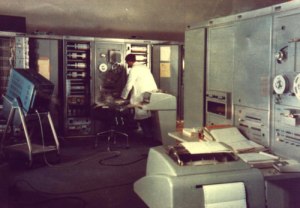
Remember your first bicycle or motor car? Or the excitement you had with your very first camera? I am thinking about my very first engagement and love affair with computers, with the Scientific Data Systems 910 and 920. I courted them for seven years from 1965 to 1971 during my time at the Hartebeeshoek Tracking Station. See photo! These were the modest main frames installed at all the NASA Deep Space Network (DSN) facilities around the world. I say modest, because, though state of the art back then, compared to the average home desktop computer today they were very modest indeed! Though slow and awkward they were nevertheless indispensable links in the chain that would eventually put people on the Moon.

For the technically minded, the 920 specifications:

The  SDS  920  is  a  high-speed,  low-cost,  general-purpose digital  computer  with  the  following  characteristics:
24-bit  word  plus  parity  bit
Basic  Core memory  4,096 words  expandable to  16,384 words,  all  addressable
Parity  checking of all  memory  and  input/output operations
Memory  non-volatile  with  power  failure
FORTRAN  II  and  Symbolic  Assembler  as  part of  complete software  package
All  silicon  semiconductors
Dimensions:   66"  x  48"  x  27"
Power: IIOV,  60  cps,  10  amps
Input/Output:
Standard:
30G  character/second Paper  Tape  Reader
60  character/second Paper  Tape  Punch
Automatic  Typewriter
Dual-channel  Priority  Interrupt
Display  and manual  control  of  internal  registers
Optional:
Magnetic  Tape  Systems  (IBM  compatible)
Line  Printer
Direct communication  with  I ~ 7090,  A/D converters,  etc.
Much of this success was due to the use of silicon-based transistors in their earliest designs, the 24-bit SDS 910 and SDS 920 which included a hardware (integer) multiplier. These are arguably the first commercial systems based on silicon, which offered much better performance for no real additional cost. Additionally the SDS machines shipped with a selection of software, notably a FORTRAN compiler, developed by Digitek, that made use of the systems' Programmed OPeratorS (POPS), and could compile, in 4K 24-bit words, programs in a single pass without the need for magnetic tape secondary storage. For scientific users writing small programs, this was a real boon and dramatically improved development turnaround time. - http://en.wikipedia.org/wiki/Scientific_Data_Systems
Oh wow!

The first SDS 910/920's were ordered and built in 1962 and some continued in use as late as 1985. Functionally, the SDS computers took data received from the spacecraft and formatted and recorded it on magnetic tape. A computer at the Jet Propulsion Laboratory  in Pasadena processed the data further.

When I left Hartebeeshoek to enter the ministry, I was presented with a book, This Island Earth, (NASA 1970). It was inscribed with the words, "With best wishes from the 920's" and signed by the Telemetry and Command Processing Staff of DSIF-51. It is a book I treasure to this day, a memento of a first love.

These are the days of miracle and wonder
This is the long distance call
The way the camera follows us in slo-mo
The way we look to us all
The way we look to a distant constellation
That's dying in a corner of the sky
These are the days of miracle and wonder
                                        - Paul Simon
References:
Wikipedia, Scientific Data Systems, http://en.wikipedia.org/wiki/Scientific_Data_Systems
Allen Kent and James G. Williams (Ed), Computers in Spaceflight: The NASA Experience,
Douglas J. Mudgway, Uplink-Downlink: A History of the Deep Space Network,

©Colin G Garvie
HomePage: http://www.garvies.co.za